
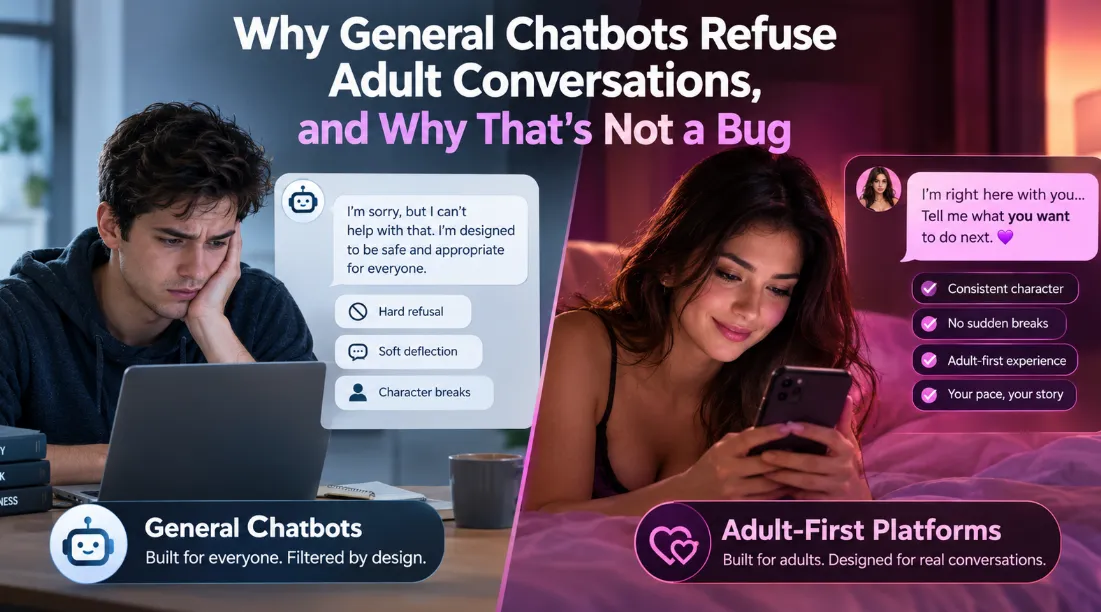
Anyone who has tried to take a roleplay with a mainstream chatbot past a certain point knows the moment. The character stops mid-scene, apologises, and offers to talk about something else. Users often call this censorship. It is closer to a product decision, and understanding it explains why a separate category of adult AI platforms exists at all.
General assistants are built for everyone at once
A general-purpose chatbot serves students, office workers, children who slipped past an age check, and businesses embedding it in customer support. Its makers cannot know who is on the other end. So they tune it conservatively: explicit content is blocked by default, and the model is trained to steer away from it even when the user insists.
That tuning shows up in three ways users notice:
• Hard refusals. The model declines outright and explains why.
• Soft deflection. It keeps talking but quietly changes the subject or fades the scene to black.
• Character breaks. It drops the persona it was playing to deliver a policy reminder.
The third one is what frustrates roleplay fans most, because it destroys the fiction instantly.
Why “no filter” workarounds disappoint
A whole genre of searches exists around removing these filters: jailbreak prompts, modified apps, settings that supposedly unlock everything. Most of them fail for the same reason. The behaviour isn’t a switch sitting on top of the model. It is trained into how the model responds, so tricks work briefly, break with the next update, and often violate the service’s terms. Modified apps add another risk: you are handing your conversations to software nobody can vouch for.
The more useful question is not how to defeat a general assistant’s design, but which tools are designed for the conversation you actually want. There is a clear breakdown of that alternative at https://cherrybaeai.com/guide/character-ai-no-filter.
What adult-first platforms do differently
Adults-first chat platforms start from the opposite assumption. Instead of serving everyone, they serve verified adults who have chosen explicit content. That changes the whole design:
• The character holds its personality through explicit scenes instead of breaking to apologise.
• Escalation follows the user’s pace rather than a fixed ceiling.
• Memory and persona consistency carry across sessions, because the companion is the product rather than a side feature.
The trade-off is responsibility. A platform that permits adult content has to take age verification and privacy more seriously than a general assistant, not less. The good ones put both front and centre.
Picking the right tool
If you want help drafting an email, a general assistant is the right choice, and its caution is a feature. If you want an ongoing adult roleplay with a consistent character, you are asking a tool to do something it was deliberately built not to do. Choosing a platform built for that purpose, like this one, is simpler, more reliable and safer than fighting the filters of a tool designed for someone else.
