
More website traffic, busier social feeds and thicker monthly reports do not necessarily mean more customers. Before deciding that you need the “digital marketing agency in Singapore”, find out where your marketing is actually breaking down.
Updated November 12, 2026 · Practical guide for business owners and marketing leaders
Imagine a company that has increased its advertising budget for three consecutive quarters. Its agency reports healthy impressions, cheaper clicks and growing website sessions. Yet the sales team says incoming inquiries are less relevant than before. Management responds by asking for even more leads.
Buying more traffic may be precisely the wrong answer. The real problem could be an offer that does not resonate, a landing page that attracts the wrong audience, slow sales follow-up, or conversion tracking that counts every form fill as a qualified prospect. A different agency might help, but only if it diagnoses the underlying problem instead of repeating the same tactics.
This guide explains how to separate a genuine agency performance problem from a wider marketing problem, what warning signs to look for, and how to evaluate a replacement fairly. It does not invent a league table of “top” agencies: there is no universally best provider for every industry, budget and growth stage.
The short answer
Look beyond deliverables and ask whether your marketing partner can connect business goals → the right audience → effective campaigns → qualified inquiries → paying customers. If that chain is not measurable, fix measurement first. If it is measurable but the agency cannot explain or improve the weak links, you have a stronger reason to review your options.
In this guide
-
Diagnose the problem first
-
10 warning signs
-
Fix the relationship or switch?
-
What a good agency actually does
-
Agency comparison scorecard
-
Budgets, contracts and case studies
-
A practical 90-day plan
-
Frequently asked questions
1. Before blaming the agency, diagnose the marketing problem
Marketing is a sequence of handoffs. Each stage depends on the previous one, but it has a different owner and a different measure of success. Search ads may bring relevant visitors who encounter a slow mobile website. A strong landing page may generate inquiries that sales staff never call back. Your agency may even be optimizing toward form submissions that are mostly spam.
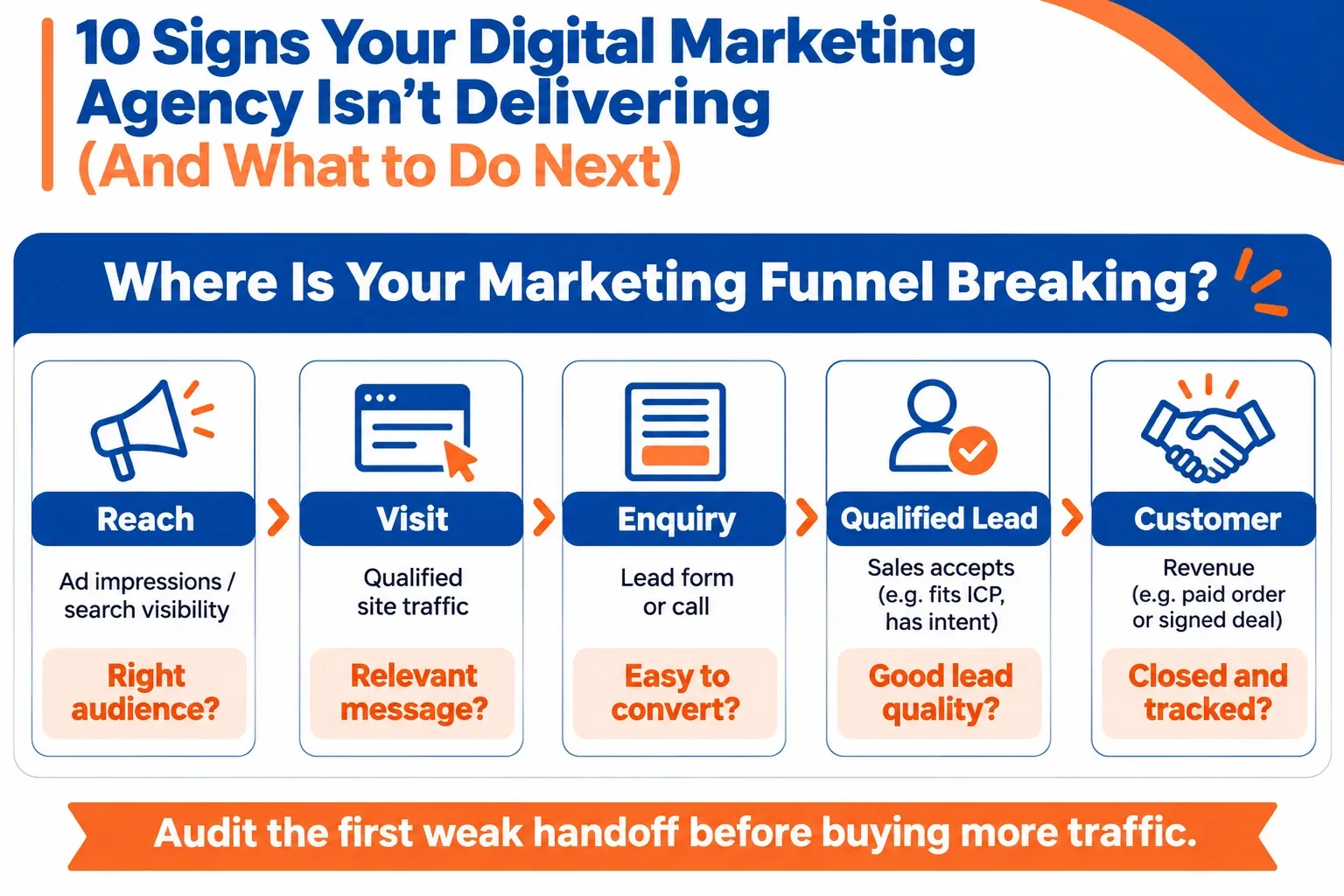
Infographic 1. Find the first weak handoff in the marketing funnel before increasing media spend.
|
Symptom |
First thing to check |
Useful metric |
|---|---|---|
|
Traffic is increasing, but leads are flat |
Audience intent, landing-page relevance, page usability and form completion |
Qualified inquiries per relevant visitor |
|
Lead volume is up, but sales are not |
Lead qualification, response time and sales handoff |
Sales-qualified lead rate and close rate |
|
Ad spend rises faster than revenue |
Campaign mix, creative fatigue, bidding signals and customer acquisition economics |
Customer acquisition cost and contribution margin |
|
SEO rankings improve, but inquiries do not |
Search intent, commercial page coverage, lead capture and attribution |
Organic qualified leads and assisted revenue |
|
The agency reports results you cannot reconcile |
Tracking setup, event definitions, CRM data and attribution windows |
Reconciled leads and closed-won revenue |
Make the measurement distinction explicit: a lead is not automatically a qualified lead, a qualified lead is not automatically a customer, and return on ad spend (ROAS) is not the same as business profit. In Google Analytics 4, important website actions are called key events; Google Ads uses conversions to measure and optimize advertising outcomes. Neither system automatically replaces your sales records.
An illustrative example, not a client case study: Suppose S$6,000 in ads generates S$18,000 in attributed sales. That is 3.0× ROAS, but it is not a 200% profit margin. Product costs, staff time, agency fees, refunds and repeat purchases still matter. A good agency explains which costs and revenue definitions its ROI claims include.
2. Ten warning signs your digital marketing agency may be underperforming
Any one sign can have an innocent explanation. The concern is a pattern: weak outcomes, little curiosity about why they happened, and no accountable plan to improve them.
Warning sign 01: Reports celebrate clicks and impressions but never reach sales
Clicks, rankings and engagement matter as diagnostic measures. They do not explain whether marketing is creating commercial value. If every meeting ends with a prettier dashboard but no discussion of customer quality, revenue or your next decision, reporting has become the product rather than a tool for improvement.
Ask: “Which reported change should influence our budget or strategy this month?” A useful review explains what improved, what failed, the likely reason and what the team will test next.
Warning sign 02: The agency cannot distinguish a lead from a qualified opportunity
A campaign can appear successful by generating many low-intent inquiries. For B2B firms, useful downstream stages may include sales-accepted lead, qualified meeting, opportunity created and deal won. For e-commerce, the equivalent might be completed purchase, average order value, repeat purchase and margin.
Ask: “Can we reconcile the platform’s reported conversions with actual inquiries and customers in our CRM?” If not, the immediate job is to agree definitions, identifiers and lawful data-sharing arrangements, not to promise cheaper leads.
Warning sign 03: Paid acquisition costs keep rising without a testing plan
Advertising costs can increase because of competition, seasonality, a smaller audience, poor creative, irrelevant landing pages or changing conversion rates. No agency controls every auction. It should, however, have hypotheses and a deliberate experiment program.
Ask: “What did we test in the last 30 days, what changed, and what did we learn?” Look for experiments with a clear objective, sufficient data and documented decisions rather than arbitrary budget shifts.
Warning sign 04: More website traffic produces fewer meaningful inquiries
Traffic growth is not useful if it comes from the wrong searches, locations or audiences. A blog can attract large informational audiences while your product pages remain invisible to people ready to buy. The same issue occurs when ad creative promises something the landing page cannot deliver.
Ask: “Which landing pages and search terms are producing qualified prospects?” Review visitor intent, form friction, calls and lead quality before commissioning more content or media.
Warning sign 05: The SEO program is built around rankings rather than business intent
A keyword can climb to page one and still bring very little revenue. Rankings should be interpreted alongside the terms customers use when comparing solutions, the usefulness of the landing page and whether prospects take the next step.
Ask: “Show us the pathway from our target searches to our commercial pages and qualified inquiries.” A sound SEO program addresses technical barriers, useful content, internal linking, commercial intent and conversion opportunities, not just a fixed keyword count.
Warning sign 06: AI search or GEO is sold as a guaranteed shortcut
AI-assisted search is becoming part of how prospects discover and compare businesses. That makes AI visibility worth discussing. But any promise that a vendor can guarantee your appearance in ChatGPT answers or Google AI Overviews should be interrogated carefully.
Google’s own AI features guidance says established SEO practices remain relevant, and that there is no special technical requirement for appearing in its AI Overviews or AI Mode beyond ordinary search eligibility. Ask what the agency will actually improve, how it will measure visibility and how it will separate brand discovery from attributable revenue.
Warning sign 07: Every business receives the same channel mix and content calendar
A local clinic, enterprise software firm and online retailer have different buying journeys. One may need local discovery and reputation signals, another long-cycle B2B demand generation, and another conversion rate improvement across high-volume product pages. A standard bundle is not automatically bad, but a standard strategy is.
Ask: “Why are these three activities the right priorities for our business, and what would you deliberately not do?” Strong advice involves trade-offs.
Warning sign 08: The agency does not understand your actual Singapore buyers
Singapore-specific work may involve English and Chinese queries, mobile-first journeys, local search intent, multi-market expansion, compliance-sensitive sectors or long B2B approval chains. None of these is universal. They matter only when they match your real customers.
Ask: “What have you learned about our audience that would change our messaging, channels or landing pages?” Beware of agencies that replace customer research with broad statements about “what Singaporeans do”.
Warning sign 09: No one is accountable for strategy, delivery and decisions
Even a technically talented team can underperform if the account changes hands repeatedly, actions go unowned, or everyone assumes another party handles the website and CRM. Agencies should explain who leads strategy, who performs the work, who approves changes and how issues are escalated.
Ask: “Who is our day-to-day owner, who can make strategy decisions, and what happens if the plan misses its milestones?” Then check whether the names in the proposal match the team actually serving you.
Warning sign 10: You cannot access your own accounts, creative assets or performance data
Before signing, clarify who owns your advertising accounts, analytics properties, website, source files, tracking configuration, content and historical data. If you cannot continue operating when a contract ends, the commercial risk is significant even if current results look acceptable.
Where customer personal data is involved, establish who may access it, how it is protected and what happens on termination. Singapore’s PDPC guide to managing data intermediaries highlights the need for clear oversight and responsibilities when processing is outsourced.
3. Should you fix the current relationship or change agencies?
A weak quarter does not prove your agency is incapable. Search demand can change, campaigns may need learning time, and product or sales challenges can sit outside an agency’s control. Before a disruptive switch, give the current team a fair opportunity to diagnose and address the problem.
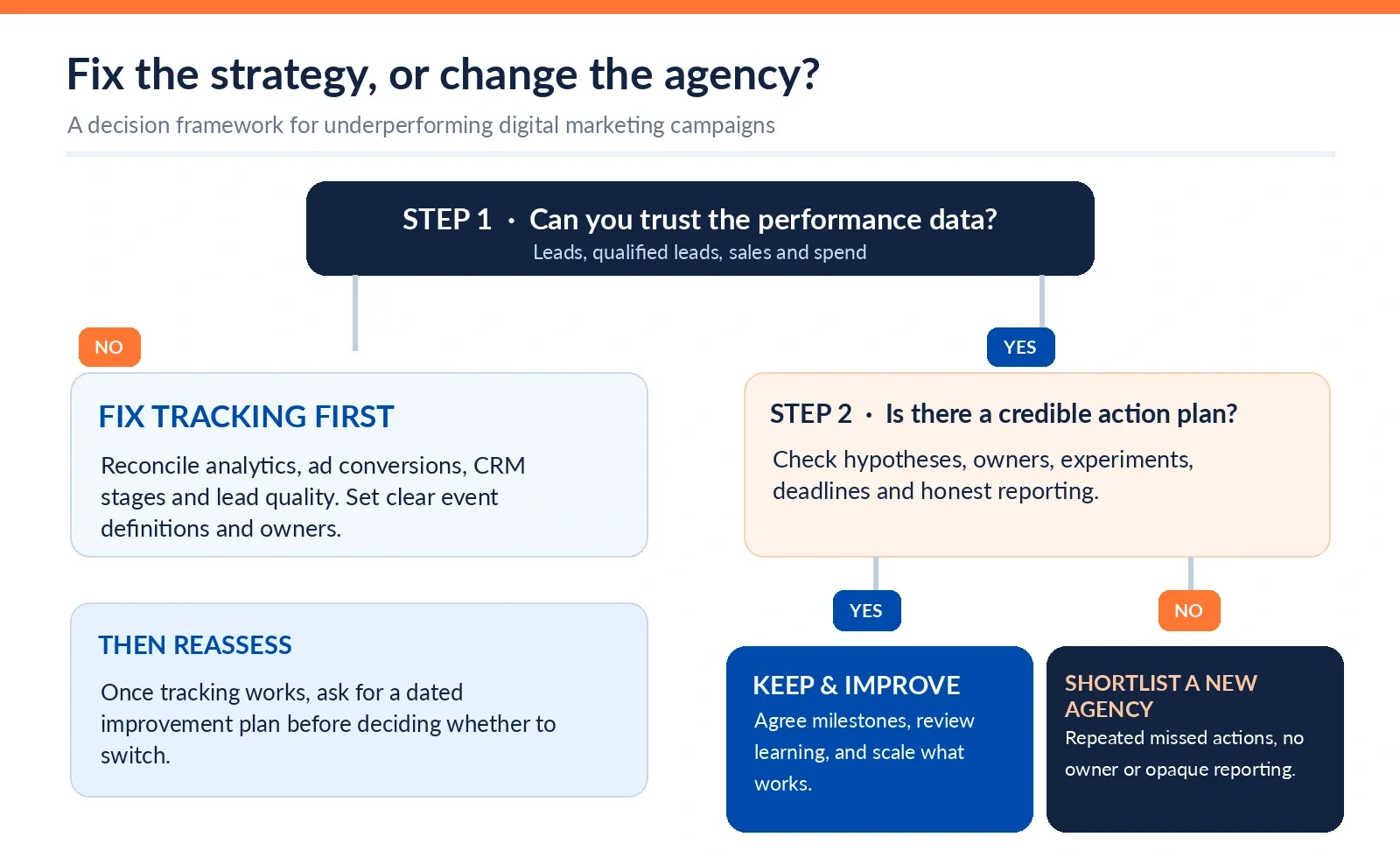
Infographic 2. Fix tracking and accountability first; switch when the pattern is poor delivery and no credible corrective plan.
|
Keep and improve when… |
Consider switching when… |
|---|---|
|
The team acknowledges the problem and shares the underlying data. |
It repeatedly withholds account access or refuses to explain results. |
|
There is a prioritized plan with owners, experiments and review dates. |
Reviews are dominated by excuses, vanity metrics and recycled slides. |
|
Missed targets are explained against clear assumptions and market context. |
Basic commitments and corrective actions are repeatedly missed. |
|
Both agency and client agree what sales, product and marketing must each fix. |
The agency sells more services without solving known measurement or funnel gaps. |
When a change is justified, plan the handover carefully. Export reports, document campaigns, retain admin permissions and record dependencies before the outgoing team disengages. Avoid resetting working campaigns or breaking conversion tracking merely to start with a clean account.
4. What should the best digital marketing agency for your business actually deliver?
The word “best” needs a qualifier: best for which business challenge? A specialist agency can be a better choice than a large integrated firm for one clearly defined problem. Conversely, a coordinated full-funnel team may be more useful when your SEO, advertising, website and CRM all require improvement.
|
Your priority |
Capabilities to prioritize |
Evidence to request |
|---|---|---|
|
Lead generation for a local SME |
High-intent search, local SEO, fast landing pages, call/form tracking |
Qualified inquiry volume, conversion rate, lead-handling process |
|
B2B demand generation |
Audience research, content, paid search or LinkedIn, CRM integration, nurturing |
Lead quality, opportunities created, sales-cycle context |
|
E-commerce growth |
Paid media, product feed management, merchandising, SEO and CRO |
Revenue, gross margin, new-customer cost, repeat purchase |
|
Brand awareness or category creation |
Creative strategy, video, PR, community, audience measurement |
Reach quality, brand/search lift methodology and later-stage demand signals |
|
AI search discovery |
Technical SEO, clear useful content, factual brand information and appropriate measurement |
Search Console trends, relevant AI citations where observable, business impact caveats |
A credible agency connects disciplines instead of selling them in isolation. That does not mean purchasing every service. It means identifying the bottleneck and choosing a level of support suited to the business. For instance, if your paid social campaigns drive inquiries but customers complain about slow follow-up, the most valuable next step may be a CRM and sales process improvement rather than another set of creatives.
5. Compare shortlisted agencies with a weighted scorecard
Shortlist two or three firms with different strengths, then give them exactly the same brief. Ask each to show how it would diagnose your weakest funnel stage, what it would do in the first 90 days and how its recommendations would be measured. Price alone is a poor comparator when proposed deliverables vary widely.
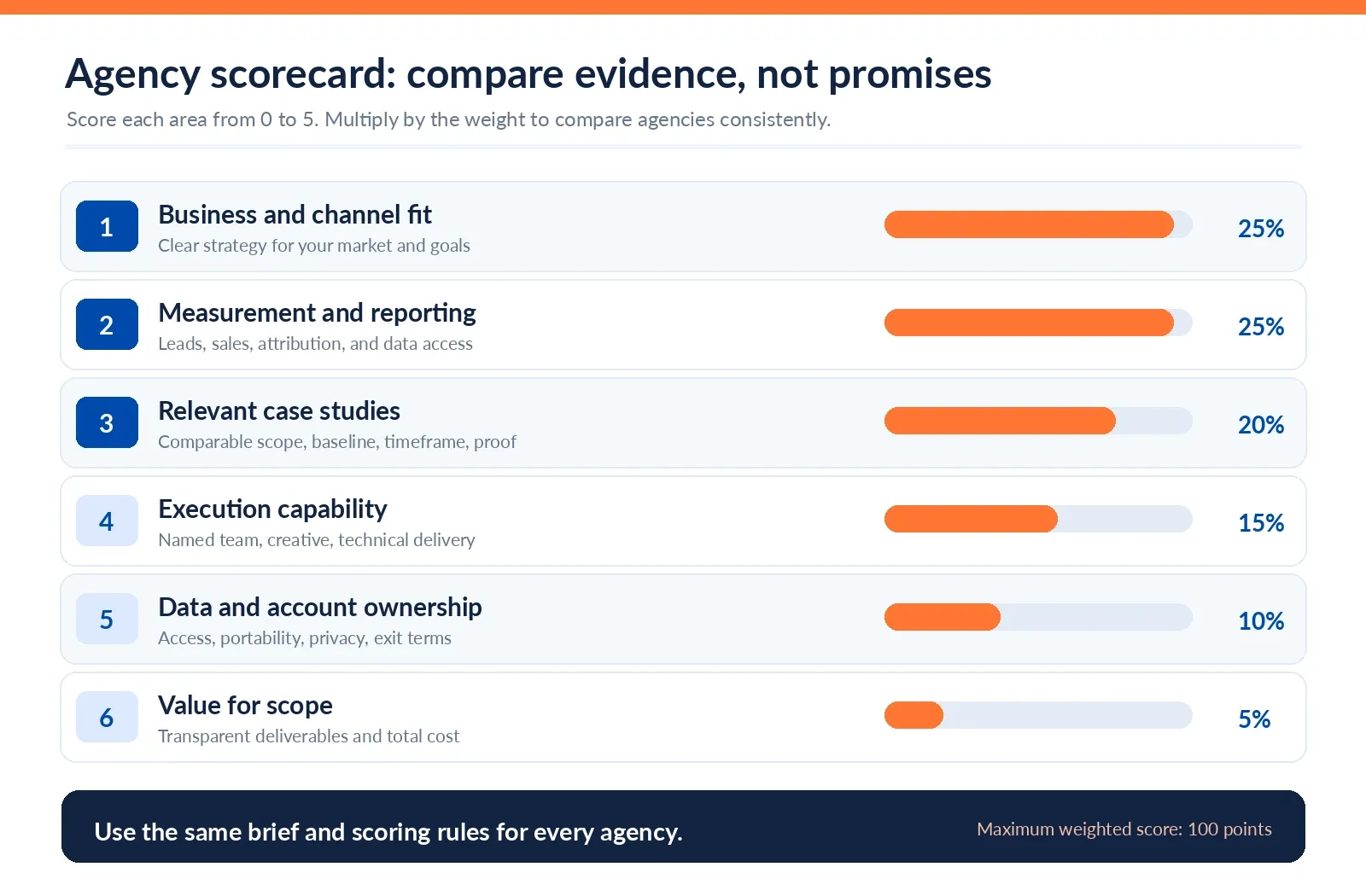
Infographic 3. Example weighted selection framework; adjust the weights to your organization’s priorities.
The scoring method is simple: rate each agency from zero to five for each criterion, divide that score by five, multiply by the stated weight, then add all six results. A score of five out of five on a 25-point criterion earns 25 points; three out of five earns 15. This is an illustrative decision framework, not an external agency ranking.
Six questions that separate strong proposals from impressive sales decks
-
What exactly will you diagnose before changing the strategy? Look for customer, channel, tracking, landing-page and funnel analysis rather than an instant package recommendation.
-
Which case study is genuinely similar to us? Ask for the starting point, campaign period, budget or scope, methods, measurement source and limitations.
-
What are the first three experiments? Each should have a hypothesis, owner, success measure and decision date.
-
Who does the actual work? Meet the lead strategist or account owner and understand in-house versus subcontracted responsibilities.
-
Who controls the data and accounts? Clarify ownership, permissions, exports, privacy safeguards and handover terms before work starts.
-
What will our total cost include? Separate agency fees from media, production, technology, implementation and tax.
Credentials are a supporting signal, not a substitute for results. For paid-search providers, you can independently check Partner or Premier Partner status through the Google Partners directory; Google notes that directory listing itself is not an endorsement.
6. What should a digital marketing agency cost in Singapore?
There is no single verified “going rate” for digital marketing. A small search-ad management arrangement and an integrated program covering SEO, creative, paid media, web optimization and CRM reporting involve completely different amounts of work. Published agency budgets are useful as planning context only, not market-wide averages.
For planning purposes, a business might model S$2,000–S$4,000 per month for a narrowly defined channel, S$5,000–S$10,000 for broader demand-generation work, or S$10,000–S$20,000 for a substantial multi-channel scope. These are illustrative planning scenarios, not verified Singapore market averages, actual agency quotes, or recommended minimum spends. Ask for itemized proposals before setting a budget.
|
Budget component |
What to clarify |
Why it matters |
|---|---|---|
|
Agency management fee |
Strategy, channel management, hours, meetings, senior oversight |
Defines actual service and accountability |
|
Media spending |
Paid directly to platforms or billed through agency; taxes and markups |
Determines what reaches the advertising auction |
|
Content and creative production |
Number of assets, formats, revisions, licensing and ownership |
Prevents unexpected production costs |
|
Web and tracking implementation |
Landing pages, tag setup, CRO tests, CRM integration |
These often determine whether traffic converts |
|
Tools and third-party costs |
Software seats, dashboards, data connectors and subscriptions |
Affects the total cost and handover |
Illustrative monthly budget only: A S$10,000 plan might allocate S$5,000 to advertising media, S$3,000 to strategy and management, S$1,000 to creative and S$1,000 to measurement or landing-page improvements. Another business may need a completely different split. The allocation is an example for comparing quotations, not an actual agency quotation.
How to judge case studies without being misled
It is reasonable to ask for evidence, but dramatic percentages are not useful without context. A campaign that grew from two leads to six can boast 200% growth; it still produces only four additional leads. Any portfolio figure should tell you what changed, over what period, from what starting point, and how performance was attributed.
-
Baseline: What was performance before the work began?
-
Business outcome: Was the result traffic, inquiries, qualified opportunities, sales or profit?
-
Scope: Which channels, markets, budget levels and client teams contributed?
-
Timeframe: Were seasonal or one-off effects considered?
-
Verification: Can the agency show a report extract, measurement method or reference, subject to client confidentiality?
Avoid relying on unrelated overseas-agency directories or unsupported success anecdotes when making a Singapore purchasing decision. Request directly comparable evidence instead.
7. A realistic first 90 days with a new agency
No responsible agency can promise that every channel will become profitable within 90 days. The first quarter should instead establish trustworthy data, useful tests, accountability and evidence that the strategy is moving in the right direction. SEO and brand-building often need a longer horizon than a short paid-media test.
|
When |
Priority |
Concrete output |
|---|---|---|
|
Days 1–15 |
Understand the business and audit existing performance |
Baseline, funnel map, data access checklist, tracking QA and prioritized problems |
|
Days 16–30 |
Agree what success means and fix critical issues |
KPI definitions, qualified-lead rules, campaign plan, owners and test calendar |
|
Days 31–60 |
Run controlled improvements |
Audience, message, landing-page or creative tests with documented findings |
|
Days 61–90 |
Review evidence and decide what to scale |
Performance review, lessons, next-quarter roadmap and budget recommendation |
During onboarding, be equally clear about your own responsibilities. If the agency needs sales outcomes, approvals, product details, brand guidance or web changes to do its job, name an internal owner and a response timeline. Good marketing partnerships are accountable on both sides.
Frequently asked questions
How do I know whether my digital marketing agency is underperforming?
Look for a repeated gap between agreed business goals and reported results, combined with inadequate diagnosis, weak measurement or missed improvement commitments. One disappointing month on its own is not conclusive. Compare channel results, lead quality, customer outcomes and market context before deciding.
Which is the best digital marketing agency in Singapore?
There is no objective winner for every business. The best fit depends on your goals, industry, budget, required services, team chemistry and ability to demonstrate relevant results. Use the same brief and selection scorecard for each shortlisted agency rather than relying on a generic top-ten list.
Should I choose a specialist or full-service digital marketing agency?
Choose a specialist when your problem is narrow and well defined, such as technical SEO remediation or paid-search optimization. Consider an integrated team when the bottleneck crosses several functions such as campaigns, content, website experience, measurement and CRM handoff.
How quickly should an agency generate results?
Paid campaigns can produce early diagnostic signals once tracking is working, while reliable cost and conversion patterns depend on volume and buying cycles. SEO can require months of technical, content and authority work before meaningful business results emerge. Ask for milestones and an evidence-based roadmap instead of a universal deadline.
What should I own if I change agencies?
Seek administrator access and contractual clarity over your advertising accounts, website, analytics, tag manager, CRM integrations, domains, creative assets, source files and reports. Specify data-export and transition support, including how personal data will be handled at handover.
Does a digital marketing agency need to offer GEO or AI search optimization in 2026?
It should be able to explain how changes in search discovery affect your audience and what can realistically be measured. That does not mean every business needs a separate GEO retainer. For Google’s AI search features, foundational technical SEO, accessible content and useful original information remain important. Evaluate proposed AI-search services on deliverables and evidence rather than novel acronyms.
Conclusion: choose the agency that can solve the right problem
If your pipeline is flat, do not start by asking which agency has the most awards, the longest service menu or the cheapest monthly retainer. Start by identifying where potential customers are lost and which parts of that process the agency can influence.
The agency worth hiring is the one that can explain the diagnosis, prioritize the work, show relevant evidence, make the numbers understandable and accept accountability for agreed actions. That is a more useful definition of the best digital marketing agency for your business than any generic ranking.
