
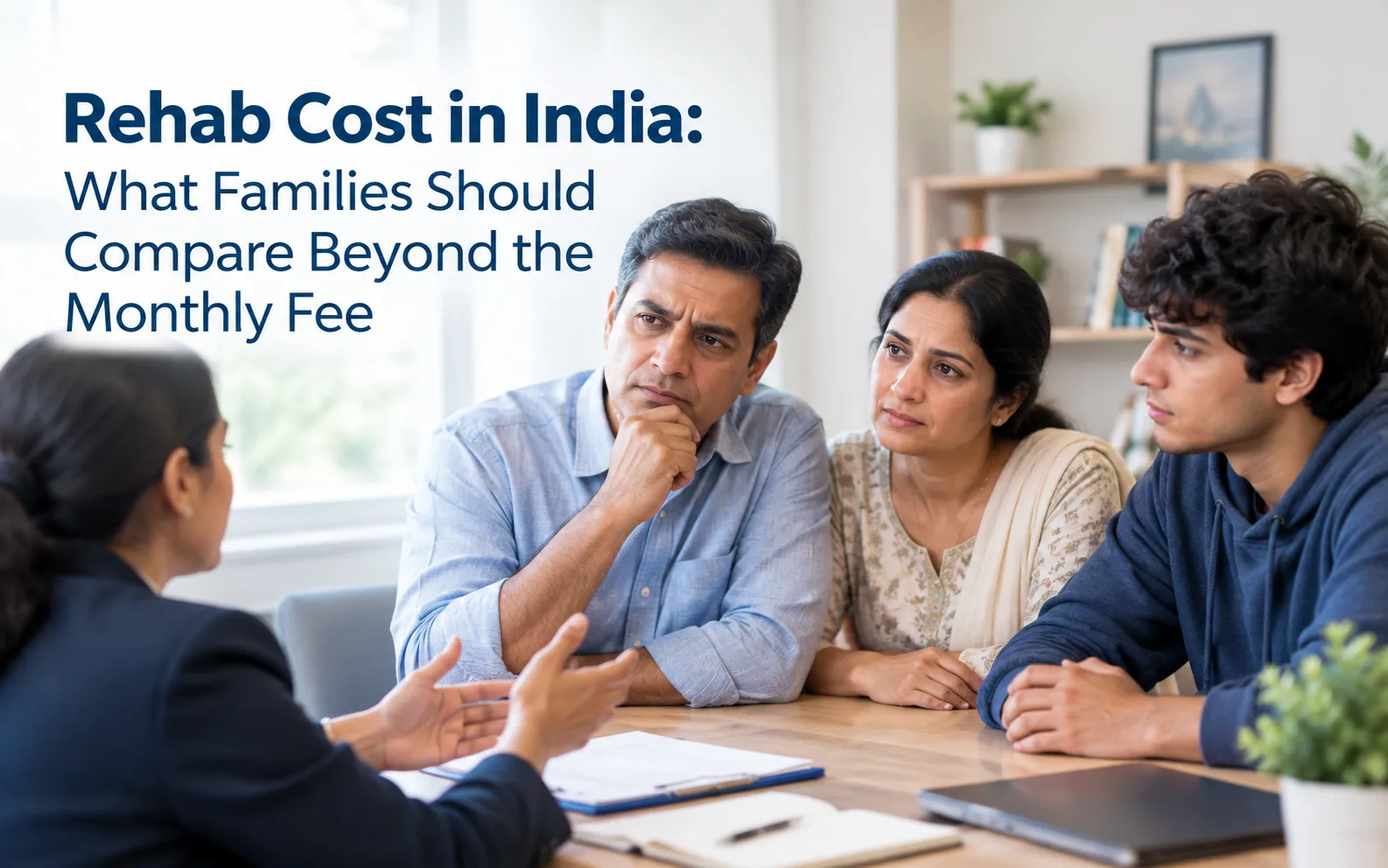
The first financial question families ask is usually, ‘How much will one month of rehab cost?’ The problem is that a monthly number can hide more than it explains. One programme may include most clinical care in the package. Another may charge separately for medical consultations, medicines, laboratory tests, special nursing and emergency transfer. A premium programme may mainly charge more for privacy and accommodation.
There is no single official private rehab tariff for India. Publicly supported de-addiction services may provide treatment free of charge, while private costs vary by location, room category, staffing and clinical intensity. That makes item-by-item comparison more useful than quoting a national average.
Separate the bed from the treatment
Ask what the residential fee actually buys. Does it include medical assessment? Psychiatric review? Individual counselling? Group work? Medicines? Tests? Family sessions? Aftercare? If these items are separate, get an estimate of the likely total rather than comparing only the room rate.
When comparing a rehab centre in Mumbai, pay special attention to medical contingencies. What happens if severe withdrawal develops? Is emergency transport charged separately? Who pays hospital costs? Does the residential fee continue while the patient is admitted elsewhere? These questions are easier to answer before a crisis.
Room category can make two similar programmes look very different in price
Shared, semi-private and private rooms can carry very different charges even when the clinical programme is broadly similar. Families should ask whether the higher category changes nursing cover, doctor access or therapy – or simply privacy, food and amenities. Comfort can matter. It should not be mistaken for treatment intensity.
Build a treatment budget, not just an admission budget
Write three columns: residential charges, possible medical extras and costs after discharge. The third column is often forgotten. It may include counselling, medical reviews, medication, transport, reduced working hours and family sessions. If the resident will return to another city, include the cost and practicality of continuing care.
Length of stay should follow need, not a sales package
Thirty-, sixty- and ninety-day packages are common ways to organise residential care, but duration should still be reviewed according to risk and progress. A person with severe dependence, repeated relapse and unstable mental health may need a different level or duration from someone with strong family support and fewer complications.
Longer is not automatically better. Shorter is not automatically more efficient. What matters is whether the person is medically stable, engaged in treatment and prepared for the environment they are returning to.
What happens after the residential bill stops?
A residential rehabilitation centre in Mumbai should be able to explain aftercare costs before discharge. Will follow-up counselling be included? Are medical reviews separate? How long are family sessions available? If substance use returns, can care be intensified without repeating the entire admission process?
Insurance should be checked with the insurer, not assumed
Coverage for psychiatric and substance-use treatment in India depends on the individual policy, provider network, exclusions, documentation and type of admission. Families should seek written confirmation from the insurer rather than relying only on a treatment centre saying that a claim ‘may be possible’. Keep prescriptions, invoices, medical records and discharge summaries.
Do not let treatment destabilise the whole household
Families sometimes borrow heavily because they feel they have one chance to save the person. Treatment can be urgent, but a financially catastrophic decision creates new stress after discharge. Compare clinically appropriate options, including government-supported services, before taking on debt that threatens rent, school fees or basic household needs.
Use the difference in price to ask better questions
If one programme costs substantially more, find out why. Is there more nursing cover? More frequent medical review? A lower resident-to-staff ratio? Specialist psychiatric care? Or is the difference mainly accommodation? Either can be a legitimate choice, but the family should know what it is paying for.
The best cost comparison starts with the required level of care and then compares the total expected expense for that level. Cheapest is not automatically poor. Expensive is not automatically excellent. Transparent is the quality that matters first.
Free treatment does not mean no treatment
Government-supported de-addiction services can provide detoxification, counselling, medicines, board and lodging without charging the patient. Availability, waiting time and facilities vary, but these services can be clinically appropriate and should not be dismissed simply because they are free.
The national de-addiction helpline 14446 can provide counselling and referral information. Families who are unsure where to begin can use public referral routes alongside their own search.
Watch for costs created by repeated incomplete care
A low-cost detox followed by no continuing treatment may lead to repeated admissions if the underlying pattern is never addressed. At the same time, paying for a long residential stay without meaningful therapy or aftercare does not create value simply because it costs more. The relevant question is whether each stage of treatment solves a real problem.
Ask how family sessions are charged
Some programmes include family work, while others charge separately. Clarify how many sessions are included, who attends and whether follow-up family counselling is available after discharge. For many patients, changes at home are an important part of maintaining progress.
Keep a small emergency reserve
Even with a clear package, unexpected medical care can occur. Families should avoid spending the entire available budget on the room category. A reserve for medicines, transport, urgent investigations or follow-up can reduce pressure if treatment needs to change.
Financial planning cannot remove uncertainty, but it can prevent a medical decision from turning into a payment crisis.
