

Most vapers’ legal knowledge is a patchwork of shop signage, forum hearsay and half-remembered headlines — which worked fine until the rules started moving. The last few years have redrawn UK vaping law more than the previous decade: single-use disposables banned from sale, a vaping products duty legislated, further powers over flavours, packaging and displays created, and enforcement sharpened around the age line. Meanwhile the durable fundamentals — the 20mg ceiling, the 2ml tank, the age of sale — remain widely misunderstood. This guide is the plain-English legal map: what you can buy and own, what sellers must and mustn’t do, where you can and cannot vape, what changed recently and what is scheduled next, and how to stay effortlessly on the right side of all of it. It is general information rather than legal advice, but for the everyday vaper it covers the whole terrain that matters — the lawful frame around learning how to vape in Britain.
The Age Line: The Rule Above the Rules
Everything in UK vaping law stands on one bright line: eighteen. It is illegal to sell any vaping product — device, liquid, pod, nicotine-free included — to anyone under 18, and illegal for an adult to buy vaping products on behalf of someone under 18, the proxy-purchase offence that catches the ‘just get us one’ favour. Retailers must operate age verification, online sellers included, and enforcement through test purchasing has real teeth including fines and, under newer powers, swifter penalties for rogue sellers. For the individual vaper the practical code is short: expect and welcome ID checks, never buy for or supply minors under any social pressure, and treat shops that visibly don’t check as shops that cut other corners too — which, as the rest of this guide shows, is a reliable inference. The age line is the deal that keeps adult access defensible; every vaper is a stakeholder in it holding.
Product Law: What a Legal Vape Looks Like
UK product rules, inherited from the TPD framework and retained post-Brexit, define the legal article precisely — and knowing the numbers turns you into your own trading-standards inspector. Nicotine e-liquid is capped at 20mg per millilitre (2%) strength; nicotine-containing bottles at 10ml; tanks and pods you vape from at 2ml capacity. Products must be notified to the MHRA before sale with ingredient disclosure and emissions data; certain ingredients are banned outright, diacetyl of popcorn-lung fame among them; packaging must be childproof and tamper-evident, carry the prescribed nicotine health warning, and skip the marketing features aimed at minors. Anything on a UK shelf claiming 30mg or 50mg strength, any 5,000-puff sealed single-use device, any warning-free glossy import — each is announcing its own illegality, and the five-second label check this series teaches (warning, ≤20mg, ingredients, UK responsible-party address) is literally a compliance inspection you can run at the counter.
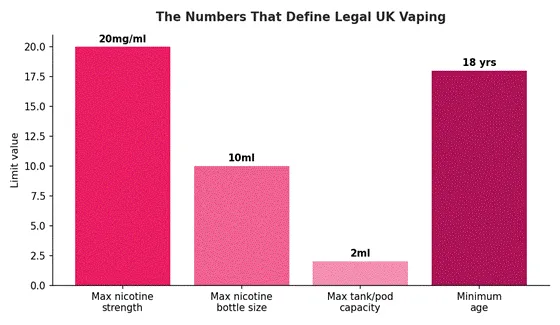
The numbers that define a legal UK vape product — strength, bottle and tank limits at a glance.
The Disposables Ban, One Year On
The most visible recent change: from 1 June 2025, the sale and supply of single-use disposable vapes became illegal across the UK — a measure driven by the environmental indefensibility of binned lithium batteries and by youth-appeal concerns. The precise shape of the rule matters: it bans selling and supplying disposables, not vaping — devices must now be both rechargeable and refillable/replaceable to be lawful, which is exactly the architecture of the pod systems that replaced them — and possession of old stock by individuals was not criminalised, though selling it is, and the under-the-counter disposable trade that persists in some shops is straightforwardly illegal, unregulated and best treated as the counterfeit fringe it overlaps with. For consumers the ban’s practical legacy is the checklist item: if a product cannot be recharged and re-podded or refilled, it has no lawful place on a UK shelf in 2026.
Where You May Vape: Law Versus Policy
The most misunderstood chapter, worth stating cleanly: the indoor smoking ban legislation covers lit tobacco and does not itself prohibit vaping — there is no general statutory ban on vaping indoors in the UK. What governs almost every real space instead is the owner’s policy, which is fully lawful to set and enforce: workplaces, transport operators, venues, hotels and landlords overwhelmingly prohibit it, and breaching policy can carry consequences from removal to, on railways and especially aircraft, byelaw offences and criminal exposure — aircraft toilets and their smoke detectors being the canonical do-not. A few specifics complete the map: vaping while driving is legal for adults but can support a careless-driving case if vapour impairs your view; some hospital trusts, sports grounds and local authorities set their own site rules, occasionally vape-friendlier than their smoking rules; and private homes and gardens answer to their owners alone. The vaper’s working rule from the etiquette guide doubles as the legal one: the space’s owner sets the law of that space — ask, and comply.
What’s Scheduled Next
Staying legal includes knowing what is en route. The headline item is the vaping products duty — an excise tax on e-liquid legislated to take effect from October 2026, applying per millilitre across nicotine strengths, with an accompanying stamps-style compliance regime for the supply chain; for consumers it will mean higher liquid prices and, notably, a sharpened gap between duty-paid legitimate stock and the illicit market, making the buy-genuine habit a tax-compliance matter as well as a safety one. Alongside it, recent legislation created powers over flavour descriptions, packaging plainness, and in-store display of vaping products, with the direction of travel toward less youth-visible presentation rather than product prohibition; and enforcement funding and penalties for underage and illicit sales have been strengthened. None of the scheduled changes bans adult vaping or the refill formats — the compliant mainstream is the protected path — but the vaper who buys from reputable channels will feel the transitions as price changes, while the grey market becomes progressively more criminal to touch.
Buying, Importing and Selling: The Consumer’s Edges
Three edge cases generate most personal-legality questions. Buying: from UK-established retailers, compliance is their burden and your five-second label check is due diligence — completed wholesale by shopping with specialists whose entire range is notified stock; pink vape operates in exactly that compliant mainstream, age-verification and all, which is the low-effort way to make this whole guide someone else’s job. Importing: bringing home personal quantities of compliant-strength product from comparable regimes is one thing, but ordering stronger-than-20mg liquid or banned formats from abroad puts you in possession of non-compliant goods and feeds the exact channel enforcement is tightening on — and post-duty, personal imports acquire a tax dimension too; the safe rule is simply to buy domestic and notified. Selling: everything above the personal — including flipping stockpiled disposables or ‘sorting out’ liquids informally — makes you a supplier in the law’s eyes, with the full retailer obligations you cannot meet from a kitchen table. Consume as a consumer; leave supply to the regulated.
If Something Goes Wrong
The remedial chapter, briefly. Sold a suspect product — impossible strength, missing warnings, a disposable in 2026? You hold normal consumer rights against the seller, and Trading Standards (via the Citizens Advice consumer service) is the reporting route that actually triggers enforcement; reporting rogue sellers is not snitching on vaping but defending the compliant market that keeps adult access open. Underage sales witnessed: same route, more urgency. A product that harms or malfunctions: the MHRA operates a reporting scheme for vaping product safety issues, and reputable retailers want to know too. And on the personal side, a vaper caught out by a space’s rules owes what this series has always advised — immediate gracious compliance — since almost every real-world ‘vaping trouble’ is a policy breach cured by an apology, not a legal event. The law, for the compliant consumer, is remarkably quiet machinery.
The Compliance Habit in One Paragraph
Distilled, staying legal as a UK vaper costs almost nothing because the system is built to make the lawful path the easy one: buy notified products from established, age-verifying UK retailers and run the label check as ritual; own rechargeable, refillable or re-poddable hardware — nothing single-use; keep strengths at or under 20mg and never import around the ceiling; vape where the space’s owner permits and nowhere transport or aviation rules forbid; never sell, supply or proxy-buy, and guard the age line absolutely; and track the duty’s arrival as a price event, not a panic. That paragraph, practised, is the entire legal exposure of a British vaper reduced to routine — and every line of it doubles as a safety habit this series has already taught for other reasons.
Legal FAQs
The statute-book questions vapers actually ask. Can I legally vape at 16 if my parents bought it? No — supply to under-18s is the offence regardless of the supplier’s relationship; the law contains no parental carve-out for vaping. Is CBD or nicotine-free liquid age-restricted too? Vaping products are restricted as a category in practice under the retail rules — expect and respect the ID check either way. Can my landlord or employer ban vaping outright? Yes — policy over private space and workplaces is theirs to set, and tenancy or contract terms make it enforceable. Are homemade or imported liquids illegal to possess? Personal possession is generally not the offence — sale and supply are — but non-compliant liquid forfeits every safeguard and, post-duty, sits progressively further outside the lawful economy; the wise habit is simply not holding it. Will the flavour powers ban my favourite fruit liquid? The legislated powers concern descriptions, packaging and display more than outlawing flavour categories wholesale — the direction is plainer presentation; watch official announcements rather than panic-buying rumours. And do I need to do anything when the duty arrives? Nothing but expect prices to step up and receipts to matter slightly more — compliance is the supply chain’s job; buying from it remains yours.
The Bottom Line
UK vaping law tells a coherent story once assembled: adult access protected, products standardised and tested, the youth-facing and throwaway fringes progressively banned, and the illicit market squeezed by enforcement and now taxation — a regime that treats vaping as what the evidence says it is, a harm-reduction tool worth keeping lawful and worth keeping from teenagers. The vaper’s part in the bargain is the short compliance habit above, worn as lightly as a seatbelt. This guide is general information, current to its writing in a moving area — the duty and display rules being the items most worth a fresh check — but its fundamentals are the durable ones. Adults 18 and over, existing smokers and vapers, buying genuine and vaping considerately: that is not just this series’ refrain; in Britain, it is more or less the law’s design brief. And for everyone outside it, the statute book and this series agree completely: nothing here is for you.
